
Seedance 2.0 Prompts for Two Characters: Clear Roles
Write Seedance 2.0 prompts for two characters with separate references, screen positions, and actions, then check for swapped roles or merged appearances.
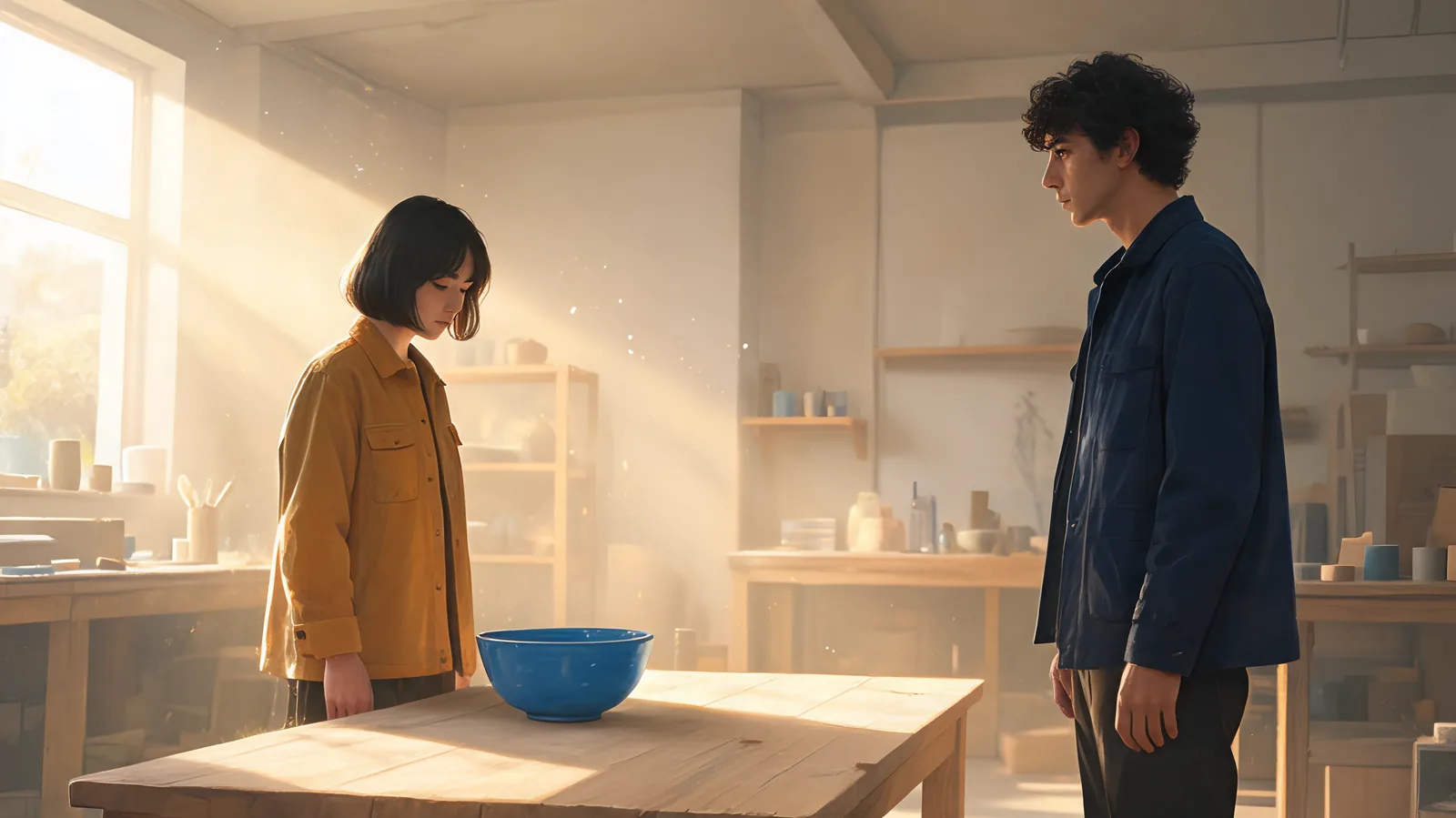
To write Seedance 2.0 prompts for two characters, define each person separately: appearance, screen position, reference assignment, and action. Keep both visible in one shot, let one make a small movement while the other watches, and name the actor again when describing the movement. This makes the intended roles easier to inspect, but it does not guarantee that faces, clothing, or actions will stay distinct.
As of October 13, 2026 · By the Seedance 2.5 Editorial Team
This tutorial uses two original fictional adults in a quiet workshop. The cover illustrates the proposed composition; it is not a demonstrated output. The prompts below are suggested starting briefs, rather than reported test results.
Build a two-person shot before adding a story
A prompt such as “two people discuss a bowl and one looks at it” leaves the main decision unresolved: which person moves? Adding a cinematic lens, emotional backstory, or detailed room description will not answer that question.
Start with a medium-wide view where both subjects are visible and separated. Choose a small action that does not require touching, passing an object, crossing paths, or hiding one face behind the other. A head turn toward an object is easier to review than a handoff with overlapping arms.
The five-step prompt method explains subject, action, camera, protected details, and ending composition. Here, the extra decision is ownership: every appearance detail and movement must belong to a particular character.
| Role | Character A | Character B |
|---|---|---|
| Appearance | Short dark bob, ochre jacket | Curly dark hair, navy jacket |
| Starting position | Left side of the frame | Right side of the frame |
| First action | Turns her head toward the bowl | Watches without moving |
| Reference purpose | Appearance of A only | Appearance of B only |
| Ending check | Still left, ochre jacket unchanged | Still right, navy jacket unchanged |
The labels A and B are convenient names in your brief. They are not special controls that enforce identity. Attach them to visible details so a reviewer can tell whether the model followed the instruction.
Assign each reference one clear purpose
Use only images you have permission to upload and use for the intended output. The reference-image rights and quality checklist is useful before you prepare any recognizable person or client asset.
For a simple first test, choose one clear appearance reference for A and one for B. Avoid photos with several people, heavily cropped faces, different outfits mixed into a collage, or backgrounds that compete with the intended scene. The aim is to reduce ambiguity about who each reference describes.
In the prompt, say what each reference is for: “The first reference describes Character A’s appearance. The second reference describes Character B’s appearance.” Match that wording to the order actually shown in the uploader. If you remove or reorder an image, update the sentence before generating.
Do not assume that another service’s special reference syntax works in this studio. Use the visible reference controls and plain language to establish the mapping. If you also add an environment image, identify it as the room reference, rather than leaving the model to decide whether it describes a third character.
As of October 13, 2026, the Seedance studio offers Seedance 2.0 with reference inputs and clips from 4 to 15 seconds. Select Seedance 2.0 deliberately; the studio also offers other model choices. Use a short clip for the initial role check and read the current settings before submission.
Write a quiet first prompt
Here is a baseline brief for a single shot. With no uploaded references, remove the reference sentence and treat the appearance descriptions as text instructions.
One continuous medium-wide shot in a sunlit workshop. Exactly two original adult characters stand apart behind a table holding one blue ceramic bowl. Character A is the woman with a short dark bob and an ochre jacket, positioned on the left of the frame. Character B is the man with curly dark hair and a navy jacket, positioned on the right. The first image reference describes A’s appearance only; the second describes B’s appearance only. A slowly turns her head toward the bowl. B stays still and watches A. Both keep their hands relaxed at their sides. Keep the camera locked, both characters visible, and their clothing distinct. End with A looking at the bowl and B still watching her. No touching, walking, extra people, or cuts.
The scene has one action owner, one observer, one object, and one camera instruction. This is a manageable question: did A turn while B stayed still? It gives you something clearer to assess than “make a natural interaction.”
The wording “exactly two” expresses the desired count; it does not make extra subjects impossible. Likewise, “keep their clothing distinct” tells the model what you care about, but you still need to check whether that happened.
Make action ownership explicit
Ambiguous pronouns are easy to overlook when you know the story. “She turns to him as they look down” can blur the order and target of the action. Restate the character’s label and one appearance anchor at the point where the movement begins.
For example: “A, the woman in the ochre jacket on the left, turns toward the bowl. B, the man in navy on the right, remains still.” That sentence is less elegant than a screenplay line, but it is easier to review against a generated frame.
Keep screen positions and character identity separate. Left and right describe the composition; A and B describe the roles. If the intended scene eventually includes a crossing movement, A remains A after changing sides. For the first test, avoid that extra demand and keep the starting positions unchanged.
Do not combine a locked camera with an orbit or a reverse shot. A cut can change the apparent left-right arrangement, which makes a role check harder to interpret. Use the camera movement guide when you are ready to introduce a deliberate move.
Review three moments and classify the error
Watch the whole clip, then pause near the opening, the middle of the action, and the ending. Identify A and B at each point from their appearance and position. A good-looking opening frame does not prove the roles remain clear through the movement.
| Observed problem | What to inspect first | Conservative next revision |
|---|---|---|
| B performs A’s action | Action sentence and pronouns | Repeat A’s label, outfit, and position beside the action |
| Outfits or faces blend | Reference clarity and subject separation | Remove conflicting images and widen the gap |
| A third person appears | Extra faces in references or a crowded setting | Use cleaner references and a simpler background |
| One subject disappears | Framing and camera movement | Keep a wider locked composition |
| Both subjects move unexpectedly | Competing action instructions | State one actor and one still observer |
Change one likely cause at a time. If both clothing and movement are wrong, start with reference clarity and the simpler action. Adding a longer list of prohibitions may hide the role assignment rather than strengthen it.
ByteDance’s Seedance 2.0 launch announcement describes multimodal references and explicitly identifies multi-subject consistency as an area that still needs improvement. That limitation matters here: a clear prompt reduces uncertainty in the brief, while the generated clip remains something to inspect.
Add a second action only after the baseline is readable
Once the first shot keeps the roles clear, try a small sequential response. Keep the references, outfits, camera, and room unchanged. Replace only the action passage:
A, the woman in ochre on the left, turns her head toward the blue bowl and settles. After A becomes still, B, the man in navy on the right, makes one small nod. A remains still during B’s nod. Both stay in their starting positions with hands relaxed at their sides.
This adds timing without introducing contact. Review whether B’s nod happens after A’s turn and whether the model keeps each motion attached to the right subject. Treat the timing as a request, rather than a frame-accurate schedule.
If both people must perform a complex movement together, consider whether your story can be edited from simpler shots. A clear two-person hold plus a separate detail shot may communicate the idea without a difficult continuous interaction. That is an editorial choice, not a promise that a particular prompt will fix anatomy or identity drift.
Keep a usable prompt and review record
Save the prompt, reference order, model choice, clip settings, and the specific error you noticed. “Roles swapped halfway through” is a useful revision note. “Bad result” gives you little guidance when you return later.
For an accepted version, record what remained stable and what still needs editing. You may accept a small background change while rejecting a switched jacket or an action performed by the wrong person. Decide those priorities before choosing the most attractive thumbnail.
Use the video editor handoff checklist when the clip moves into an edit. Review voices, rights, and any publication requirements separately. A successful silent role check does not establish dialogue accuracy or permission to use a likeness.
Frequently asked questions
How do I write Seedance 2.0 prompts for two characters?
Give each character a distinct appearance, a starting screen position, and a separate action. For a first test, keep both visible in one locked shot, have one perform a small action while the other watches, and describe which reference belongs to each character.
Will two references guarantee that the characters stay distinct?
No. References help describe the intended appearance, but the result can still swap roles, blend clothing or faces, or add an extra subject. Review the opening, middle, and ending before accepting the clip.
Should both characters move at the same time?
For a first test, let one character perform a small visible action and keep the other still. Once their roles remain readable, add the second movement as a separate revision.
What should I change if Seedance swaps the characters’ actions?
Replace ambiguous pronouns with the character’s label and visible appearance, keep the initial left and right positions explicit, and simplify to one action. Check reference assignments before adding more detail.